
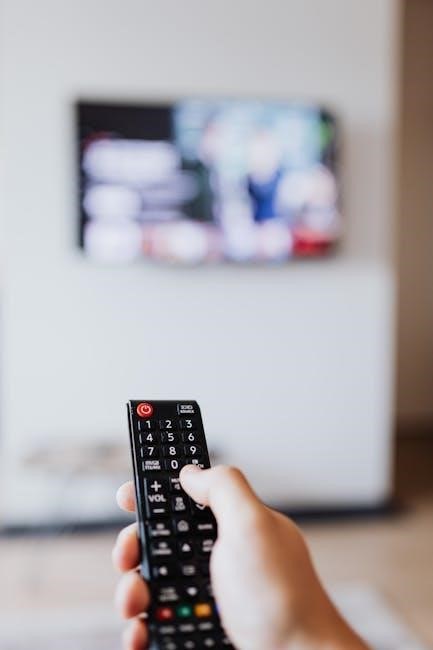
RCA Universal Remote Owners Manual: An Overview
This manual guides you through operating your RCA Universal Remote, offering assistance and ensuring successful setup. It’s your roadmap to confidently using all features.
Understanding Your Remote
Your RCA Universal Remote is designed for simplified control of multiple devices. Familiarize yourself with button layout – power, volume, channel, and menu navigation are key. This remote aims to consolidate your existing remotes into one convenient unit. Contact customer support if needed for assistance with initial operation and features.
Initial Setup and Battery Installation
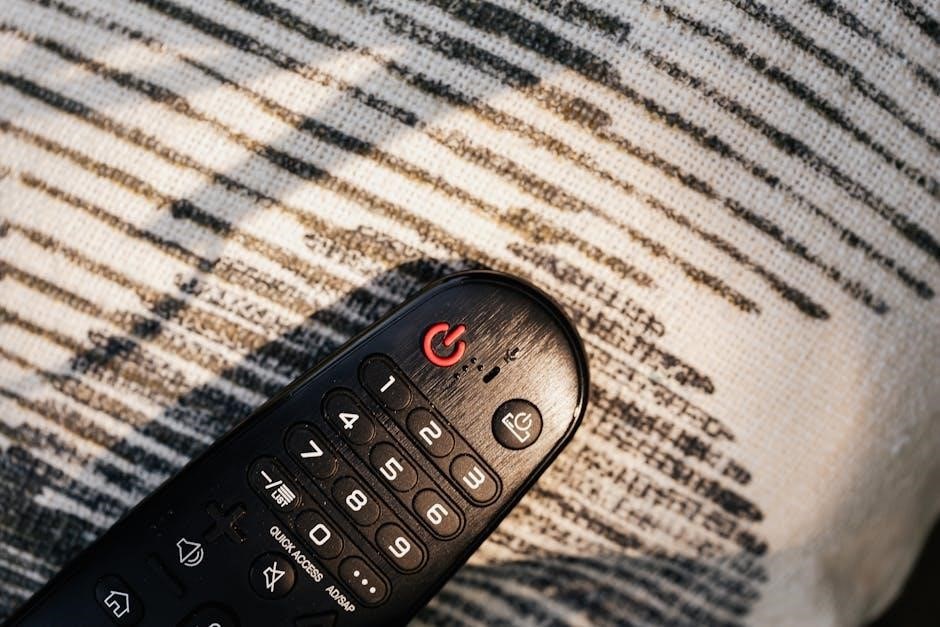
Begin by installing batteries correctly, ensuring proper polarity. This step powers your RCA Universal Remote, preparing it for device pairing and seamless operation.
Battery Type and Replacement
Your RCA Universal Remote typically requires AAA or AA batteries, depending on the model. Always use fresh batteries for optimal performance. To replace, locate the battery compartment, usually on the remote’s back. Insert batteries matching the polarity (+/-) markings. Dispose of old batteries responsibly, following local regulations. Low battery power can cause reduced range or erratic operation, so regular replacement is crucial for consistent use.
Remote Pairing with Devices
Pairing your RCA Universal Remote involves entering a device code specific to your TV, DVD player, or cable box. Consult the code list included with the remote or online at RCA’s support website. Follow the on-screen prompts, typically involving pressing and holding a ‘Setup’ or ‘Device’ button. Successful pairing allows the remote to control your device’s functions seamlessly. If unsuccessful, try alternative codes for your brand.
Device Compatibility
This remote supports a wide range of devices, including TVs, DVD players, and cable boxes. Compatibility varies; check the included device code list for specifics.
Supported Device Types (TV, DVD, Cable)
The RCA Universal Remote is designed to control numerous devices. Primarily, it supports televisions from various manufacturers, DVD players for movie playback, and cable boxes for accessing your television programming. Beyond these core types, compatibility extends to some streaming devices and audio systems. A comprehensive code list, included within this manual, details specific models and their corresponding setup codes. Regularly updated lists are also available online for newer devices, ensuring broad functionality and user convenience.
Troubleshooting Compatibility Issues
If your device isn’t responding, first verify the correct code was entered. Try alternative codes listed for your device’s brand. Ensure a clear line of sight between the remote and the device’s IR sensor. Obstructions can interfere with the signal. If issues persist, consult the online code database for updates or contact RCA customer support for assistance with compatibility concerns and potential solutions. Some older or obscure devices may lack compatible codes.

Basic Remote Functions
Essential controls include power, volume adjustment, and channel selection. Navigate menus with directional buttons and confirm selections using the ‘OK’ or ‘Enter’ button for seamless operation.
Power, Volume, and Channel Control
The power button initiates device operation, while dedicated volume controls adjust sound levels. Channel up/down buttons navigate stations, and number pad direct input is available. Some models feature a ‘mute’ function for instant silence. Ensure proper device selection before utilizing these core functions for optimal control. Experiment with the remote’s layout to become familiar with its responsive design and intuitive operation, enhancing your viewing experience.
Menu Navigation and Selection
Utilize the directional pad (up, down, left, right) to navigate on-screen menus. The ‘OK’ or ‘Enter’ button confirms selections, while ‘Menu’ accesses device settings. ‘Exit’ or ‘Back’ returns to previous screens. Explore settings for picture, sound, and other customizable options. Familiarize yourself with the menu structure of your connected devices for seamless control and personalized viewing preferences.

Advanced Features
Explore programming favorite channels for quick access and macro functionality (if supported by your model). Customize your remote for streamlined entertainment experiences and efficient control.
Programming Favorite Channels
To program favorite channels, first enter setup mode using the ‘Setup’ or ‘Magic’ button. Follow the on-screen prompts, typically involving entering a three-digit code for your TV brand. Once paired, use the number keys to select your desired channel, then press and hold the ‘Favorite’ button. Repeat this process for each channel you wish to save, allowing for instant access to your most-watched content.
Macro Functionality (If Applicable)
If your RCA Universal Remote supports macros, you can automate sequences of commands. Begin by entering macro recording mode, then perform the desired actions (e.g., power on TV, switch input, adjust volume). Save the macro to a designated button. Executing that button will replay the recorded sequence, simplifying complex operations and enhancing your viewing experience. Check your specific model’s features.
Troubleshooting Common Issues
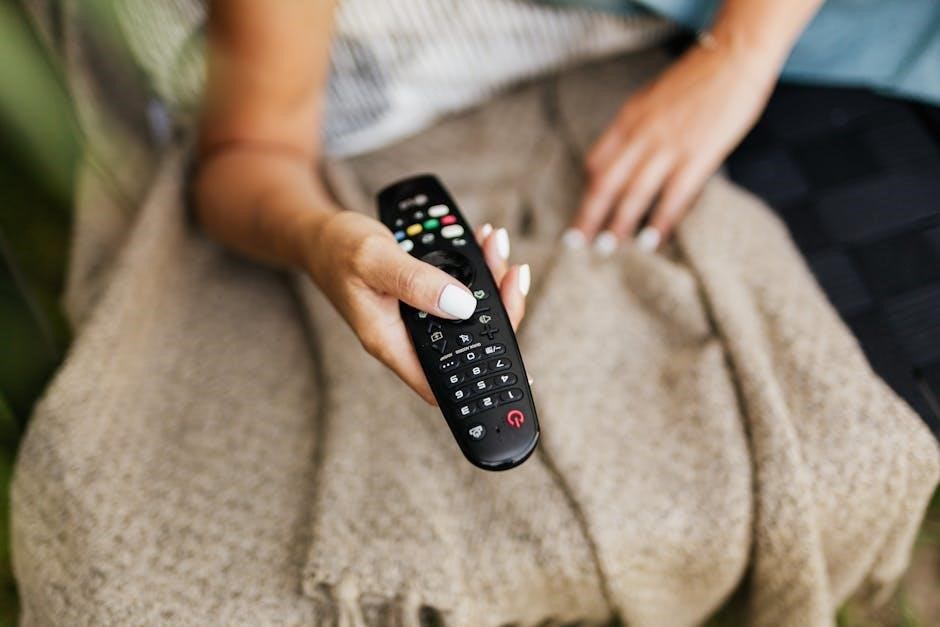
This section addresses typical problems, like the remote not responding or controlling the wrong device. Solutions include battery checks and re-pairing procedures for optimal function.
Remote Not Responding
If your RCA remote isn’t working, first ensure fresh batteries are correctly installed. Verify no obstructions block the IR sensor on both the remote and the target device. Attempt a reset by removing and reinserting the batteries.
Confirm the remote is paired with your TV or device; re-pairing might be necessary. If issues persist, check for interference from strong light sources or other electronic devices. Contact support if problems continue.
Incorrect Device Control
Experiencing incorrect device control with your RCA remote? Double-check the device code programmed into the remote matches your specific brand and model. Incorrect codes lead to malfunctioning buttons. Re-enter the code carefully, consulting the code list in the manual.
Ensure the correct input source is selected on your TV. If problems persist, try resetting the remote and re-programming all devices. Contact RCA support for further assistance.

RCA Index and Competitiveness (Contextual Information)
The RCA Index measures a nation’s export competitiveness; values exceeding 2.5 indicate strong competitiveness, while below 0.8 suggest weakness.
Understanding RCA Index Values
RCA Index values reveal a country’s comparative advantage in specific product exports. An RCA greater than one signifies exports exceeding the global average, indicating strength. Values between 1.25 and 2.5 denote moderate competitiveness, while above 2.5 represent exceptional strength. Conversely, values below 0.8 suggest weaker export capabilities, highlighting areas needing improvement for international trade success.
RCA Index in International Trade
The RCA Index is a crucial metric for assessing a nation’s position in global trade. It identifies comparative advantages, guiding export strategies and highlighting potential growth areas. A higher RCA index signals stronger international competitiveness in a specific product category. Analyzing these values helps countries focus resources and optimize trade performance, fostering economic development and market leadership.
RCA Connectors and Audio/Video Applications
RCA connectors, also known as phono plugs, are widely used for transmitting audio and video signals between devices like TVs, DVD players, and stereos.
Identifying RCA Connectors (Phono Plugs)
RCA connectors are cylindrical, commonly color-coded for easy identification. Yellow typically signifies composite video, while red and white denote right and left audio channels, respectively. These connectors, often called “phono plugs” or “AV connectors,” are found on numerous devices. Recognizing these color codes simplifies connecting your equipment, ensuring proper audio and video transmission. They are almost universally present on older and some current devices.
RCA Cables and Signal Transmission
RCA cables transmit analog audio and video signals between devices. Each cable carries a single channel – either audio (left or right) or video. Signal quality depends on cable shielding and length; shorter, shielded cables minimize interference. While reliable, RCA transmits uncompressed signals, potentially requiring higher bandwidth than digital alternatives. Proper connection ensures clear audio and video output from your source device.
RCA vs. Other Connection Types
RCA offers simplicity but lags behind HDMI and optical audio in quality and features. HDMI transmits both audio and video digitally, while optical focuses on audio.
RCA vs. HDMI
HDMI surpasses RCA significantly in modern audio-visual setups. While RCA transmits analog signals, potentially losing quality, HDMI delivers high-definition video and multi-channel audio digitally. HDMI also supports features like HDCP copy protection and CEC device control, unavailable with RCA. For newer TVs and devices, HDMI is the preferred, superior connection method offering a cleaner, more robust signal.
RCA vs. Optical Audio
Optical audio (Toslink) offers advantages over RCA for audio transmission. Optical uses light to carry digital audio, eliminating electrical interference common in RCA cables. This results in a cleaner, clearer sound, particularly noticeable with surround sound systems. While RCA transmits analog, optical delivers a digital signal, preserving audio fidelity. However, optical doesn’t carry video, unlike RCA’s combined audio/video capability.

Grounding and Noise Reduction in RCA Connections
Proper grounding minimizes noise in RCA connections. Ground loops create unwanted hum; ensuring correct grounding and shielded cables significantly reduces interference for clearer audio.
Addressing Ground Loop Issues
Ground loops occur when multiple components share a common ground path, creating unwanted noise. Isolators break this loop, preventing hum. Ensure all RCA devices share a single power source. Utilizing balanced connections, where possible, can also eliminate ground loop problems. Carefully check cable shielding and connections for optimal performance, minimizing interference and maximizing signal clarity.
Impact of Noise on RCA Signal
RCA signals, due to their lower voltage, are susceptible to noise interference. This manifests as hum, static, or distortion, degrading audio/video quality. Poor shielding, ground loops, and proximity to electromagnetic sources contribute to noise. High-quality cables and proper grounding minimize these effects. Noise significantly impacts the clarity and fidelity of the transmitted signal, requiring careful attention to connection integrity.
Balanced vs. Unbalanced RCA Connections
RCA connections are typically unbalanced, while balanced connections (using adapters like 4.4mm to RCA) offer superior noise rejection for professional audio applications.
Using 4.4mm to RCA Adapters
Adapters facilitate connecting 4.4mm balanced outputs to RCA inputs, commonly found in car audio systems or older equipment. This setup can improve signal quality by leveraging the benefits of balanced transmission, reducing noise. However, remember RCA remains fundamentally unbalanced; the adapter doesn’t magically create a balanced connection, merely allows physical compatibility. Ensure proper grounding to minimize potential interference when utilizing this configuration for optimal audio performance.
Professional Audio Applications
While RCA connectors are prevalent, professional audio often favors balanced connections (XLR) for superior noise rejection. However, RCA finds use in connecting consumer-grade devices to professional setups. Utilizing 24dBu standard levels is crucial in pro audio, demanding higher quality cables and careful grounding to mitigate noise. Adapters, like 4.4mm to RCA, bridge the gap, but inherent RCA limitations remain, impacting signal integrity compared to dedicated pro interfaces.
RCA in Different Industries
RCA connectors are widely used in audio and video equipment, including TVs, DVD players, and recording devices, facilitating signal transmission between components.
RCA in Audio Equipment
RCA connectors are fundamental in audio systems, linking devices like CD players, amplifiers, and tuners. They transmit analog audio signals, enabling sound reproduction. Professional audio often utilizes balanced RCA connections with 4.4mm adapters for superior signal clarity and reduced noise. Ground loops can introduce interference, impacting audio quality, requiring careful grounding techniques for optimal performance. RCA’s simplicity makes it a prevalent choice for connecting various audio components.
RCA in Video Equipment
RCA connectors, often called AV interfaces or phono plugs, were historically crucial for video transmission. Devices like VCDs, DVDs, and TVs commonly used them to send composite video signals. While largely superseded by HDMI, RCA remains present for compatibility with older equipment. They transmit video alongside audio, offering a simple connection method, though with lower resolution compared to modern digital standards.
Customer Support and Warranty Information
For assistance with your RCA Universal Remote, contact RCA support directly. Warranty details and coverage information are available through their official channels and documentation.
Contacting RCA Support
To reach RCA customer support for your Universal Remote, explore their official website for frequently asked questions and troubleshooting guides. Direct contact options, including phone numbers and email addresses, are typically listed within the support section. Be prepared to provide your remote’s model number and a detailed description of the issue you are experiencing to expedite the assistance process. Online chat support may also be available for immediate help.
Warranty Details and Coverage
RCA Universal Remote warranties typically cover defects in materials and workmanship for a specified period, often one year from the date of purchase. This coverage generally includes repair or replacement of the remote, excluding damage from misuse or accidents. Retain your proof of purchase for warranty claims. Specific terms, conditions, and exclusions are detailed in the warranty documentation included with your remote.