
Understanding Trigger Thumb
Trigger thumb, a painful condition, impacts thumb movement; thankfully, resources like OAH-THUMB-EXERCISES.pdf and trigger-thumb-english.pdf offer targeted
exercises for relief and improved function.
These PDFs detail passive and active motions, crucial for regaining thumb flexibility and reducing discomfort, providing a structured approach to rehabilitation.
What is Trigger Thumb?
Trigger thumb, also known as stenosing tenosynovitis, is a condition affecting the tendon in the thumb, causing it to catch or lock when bent. This occurs when the tendon sheath—the tunnel the tendon slides through—becomes inflamed and narrowed. The OAH-THUMB-EXERCISES.pdf resource highlights the importance of restoring smooth tendon gliding through targeted exercises.
The condition can range from mild discomfort to severe pain and inability to straighten the thumb without assistance. trigger-thumb-english.pdf emphasizes that early intervention, including specific exercises, can prevent the condition from worsening. These exercises, detailed in both PDFs, aim to improve range of motion and reduce inflammation, addressing the root cause of the “triggering” sensation.
Essentially, trigger thumb disrupts the natural, fluid movement of the thumb tendon, and the provided exercise protocols are designed to restore that fluidity and alleviate the associated symptoms.
Causes and Risk Factors
While the exact cause of trigger thumb isn’t always clear, repetitive hand motions and forceful gripping are frequently implicated, as suggested by the exercise focus in OAH-THUMB-EXERCISES.pdf. These motions can irritate the tendon sheath, leading to inflammation. Certain medical conditions, like diabetes and rheumatoid arthritis, also increase risk, potentially impacting exercise tolerance.
The trigger-thumb-english.pdf resource indirectly addresses risk by promoting exercises to counteract the effects of these factors. Factors like age, gender (more common in women), and occupation involving repetitive hand use contribute to the likelihood of developing the condition.
Understanding these risk factors is crucial, as preventative measures – and early exercise intervention as outlined in the PDFs – can help manage and potentially avoid the onset of trigger thumb symptoms, promoting long-term hand health.

Passive Exercises for Trigger Thumb
Passive flexion, extension, and abduction, detailed in provided PDFs, utilize your uninjured hand to gently guide the affected thumb through its range of motion.
Passive Thumb Flexion
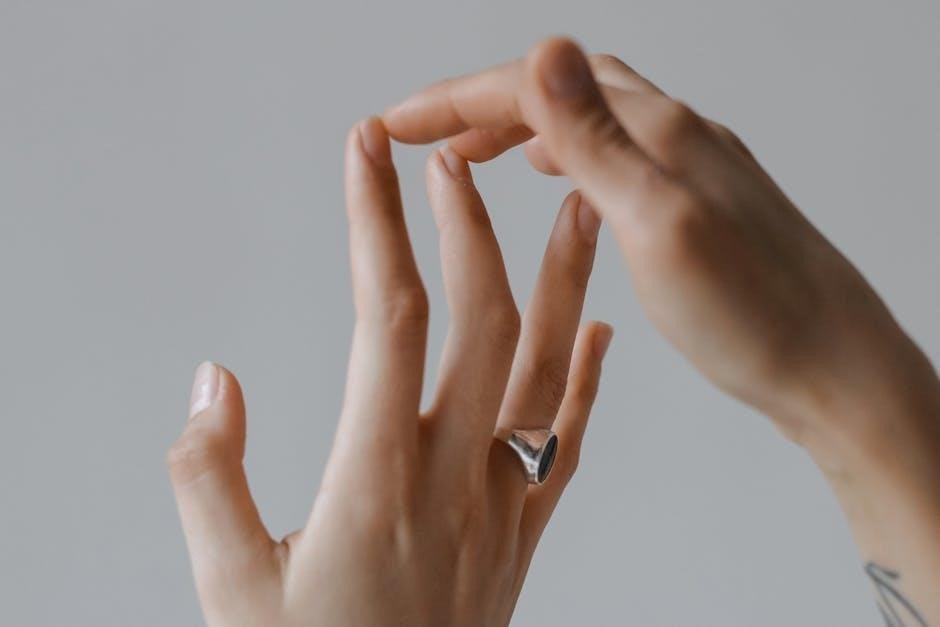
Passive Thumb Flexion, as outlined in resources like OAH-THUMB-EXERCISES.pdf, involves utilizing your healthy hand to assist the affected thumb in bending downwards. This exercise aims to gently stretch the thumb, increasing its flexibility without relying on the thumb’s own muscle strength.
To perform this exercise correctly, place your affected hand flat on a stable surface. Using your uninjured hand, carefully bend the thumb of your injured hand down towards your palm. You should feel a gentle stretch along the thumb; avoid forcing the movement or causing pain.
Hold this stretched position for 30 seconds, focusing on maintaining a relaxed yet consistent stretch. Repeat this process four times in a row, and complete this sequence three times a day for optimal results. Consistency is key to improving thumb mobility and reducing trigger thumb symptoms.
Passive Thumb Extension
Passive Thumb Extension, detailed in documents such as OAH-THUMB-EXERCISES.pdf, focuses on gently stretching the thumb outwards when your hand is resting flat on a surface. This exercise is designed to improve the range of motion in the thumb joint, counteracting the stiffness often associated with trigger thumb.
Begin by placing your affected hand flat on a table, palm down. Using your unaffected hand, carefully and gently stretch the thumb outwards, away from the palm. The stretch should be mild and comfortable; never force the thumb beyond its natural range of motion.
Maintain this extended position for 30 seconds, concentrating on a gentle, sustained stretch. Repeat the stretch four times consecutively, and perform this entire sequence three times daily. Regular practice will contribute to increased flexibility and reduced discomfort.
Passive Thumb Abduction
Passive Thumb Abduction, as outlined in resources like OAH-THUMB-EXERCISES.pdf, involves gently moving the thumb away from the palm, simulating the action of opening your hand to hold a large jar. This exercise specifically targets the muscles around the base of the thumb, promoting flexibility and reducing constriction.
To perform this exercise, position your hand comfortably. Using your unaffected hand, gently stretch the thumb outwards, away from the palm, focusing the stretch at the thumb’s knuckle – not the tip. Avoid any forceful movements; the stretch should be gentle and controlled.
Hold this stretched position for 30 seconds, ensuring a comfortable stretch. Repeat this four times, and complete the entire sequence three times each day for optimal results. Consistency is key to improving thumb mobility.
Active Exercises for Trigger Thumb
Active exercises, detailed in trigger-thumb-english.pdf and OAH-THUMB-EXERCISES.pdf, empower your thumb to move independently, strengthening muscles and restoring function.
Isolated IP (Tip) Flexion
Isolated IP (Tip) Flexion, as outlined in both the OAH-THUMB-EXERCISES.pdf and trigger-thumb-english.pdf resources, focuses specifically on bending only the tip joint of your thumb.
To perform this exercise correctly, gently hold your thumb just below the first crease, stabilizing the rest of the thumb to ensure movement occurs solely at the fingertip. Slowly bend the tip of your thumb downwards, creating a gentle flexion motion.
The OAH-THUMB-EXERCISES.pdf recommends holding this bent position for 3 seconds, then releasing. Repeat this flexion movement 10 times, completing 3 sets throughout the day. This targeted exercise helps improve flexibility and range of motion in the distal interphalangeal (DIP) joint, aiding in reducing trigger thumb symptoms.
Remember to perform the movement slowly and controlled, avoiding any forceful bending or pain.
Thumb Opposition/Flexion
Thumb Opposition/Flexion, detailed in the OAH-THUMB-EXERCISES.pdf and trigger-thumb-english.pdf documents, is a crucial exercise for restoring functional thumb movement. This exercise involves bringing your thumb to touch the tip of each finger, one at a time.
Begin by touching your thumb to the tip of your index finger, then move to your middle, ring, and finally, your pinky finger. As your thumb’s range of motion improves, gradually progress to touching further down each finger, eventually aiming to reach the base of each digit.
The OAH-THUMB-EXERCISES.pdf suggests repeating this sequence 5-10 times, performing 3 sets daily. This exercise enhances dexterity and coordination, improving the thumb’s ability to grasp and manipulate objects effectively, alleviating trigger thumb limitations.
Focus on smooth, controlled movements throughout the exercise.
Thumb Palmar Abduction
Thumb Palmar Abduction, as outlined in both the OAH-THUMB-EXERCISES.pdf and trigger-thumb-english.pdf resources, focuses on strengthening the muscles that move your thumb away from your palm. To perform this exercise, rest your hand flat on a table, supporting it with your little finger.
Gently move your thumb outwards, away from the palm, as if you are reaching to grasp a large object. Concentrate on the movement originating at the large knuckle of your thumb, rather than bending at the tip.
The OAH-THUMB-EXERCISES.pdf recommends holding this stretched position for 3 seconds, repeating the movement 10 times, and completing 3 sets throughout the day. This exercise improves thumb stability and reduces strain on the tendons.
Maintain a slow and controlled motion during each repetition.
Thumb Radial Abduction
Thumb Radial Abduction, detailed in the OAH-THUMB-EXERCISES.pdf and trigger-thumb-english.pdf documents, aims to enhance the thumb’s movement away from the palm towards the radial side (thumb side) of the hand. Begin with your hand flat on a table.
Slowly slide your thumb outwards to the side, maintaining contact with the table. Hold this extended position for 3 seconds, focusing on a gentle stretch. Then, smoothly slide your thumb back towards your index finger, again holding for 3 seconds.
According to the OAH-THUMB-EXERCISES.pdf, repeat this sliding motion 10 times, completing 3 sets daily. This exercise improves range of motion and strengthens the muscles responsible for thumb abduction.
Ensure movements are controlled and avoid any sharp pain during the exercise.
Thumb Circumduction
Thumb Circumduction, as outlined in both the OAH-THUMB-EXERCISES.pdf and trigger-thumb-english.pdf resources, involves moving the thumb in a circular motion. This exercise promotes overall thumb joint mobility and helps to loosen any stiffness contributing to trigger thumb symptoms.
To perform this exercise, gently move your thumb in a clockwise direction, completing 10 full circles. Then, reverse the direction and move your thumb in a counter-clockwise direction, again completing 10 circles.

The OAH-THUMB-EXERCISES.pdf recommends performing this exercise 3 times a day. Focus on maintaining a smooth, controlled movement throughout the circles, avoiding any forceful or jerky motions.
Pay attention to your body and stop if you experience any pain.
Exercise Frequency and Duration
PDF resources suggest performing exercises 3 times daily, with repetitions ranging from 4 to 10, depending on the specific thumb movement practiced.
Repetitions and Sets
Based on the provided PDF resources, the recommended repetition and set structure for trigger thumb exercises is fairly consistent across different movements. For passive flexion and extension, as well as passive thumb abduction, the guidance is to hold each stretch for 30 seconds, repeating the hold 4 times per set, and completing 3 sets throughout the day.
When it comes to active exercises, the number of repetitions varies slightly. Isolated IP (Tip) Flexion requires 10 repetitions, performed 3 times daily. Thumb Opposition/Flexion suggests 5-10 repetitions, also 3 times a day. Both Thumb Palmar Abduction and Thumb Radial Abduction benefit from 10 repetitions, completed 3 times daily. Finally, Thumb Circumduction involves moving the thumb in circles, 10 times in each direction, 3 times a day.
Consistency with these repetitions and sets is key to achieving optimal results and promoting healing.
Daily Schedule
The PDF resources emphasize incorporating trigger thumb exercises multiple times throughout the day for optimal benefit. A suggested daily schedule involves performing the exercises three times – morning, afternoon, and evening – to maintain consistent engagement and promote healing.
Spacing the sets out allows for regular stretching and movement, preventing stiffness and encouraging improved thumb function. It’s important to integrate these short exercise sessions into your routine, rather than attempting one long session. Remember to prioritize proper form over speed, ensuring each repetition is controlled and pain-free.
Listen to your body and adjust the schedule as needed, but aim for consistency. This regular approach, as outlined in OAH-THUMB-EXERCISES.pdf and trigger-thumb-english.pdf, will maximize the effectiveness of the exercises.
Important Considerations During Exercises
PDF guides stress gentle movements, stopping if pain arises; prioritize proper form, and consistent, controlled repetitions for effective trigger thumb rehabilitation.
Pain Management
Managing pain during trigger thumb exercises is paramount for successful rehabilitation. Both the OAH-THUMB-EXERCISES.pdf and trigger-thumb-english.pdf resources emphasize a gentle approach. Never push through significant pain; a mild stretching sensation is acceptable, but sharp or increasing discomfort signals a need to stop immediately.
If pain persists, reduce the intensity or range of motion. Consider applying ice to the affected area for 15-20 minutes after exercise sessions to minimize inflammation. Over-the-counter pain relievers, as recommended by your doctor, can also be helpful. Listen to your body and adjust the exercises accordingly. Consistent, pain-free movement is more beneficial than aggressive exercises that exacerbate symptoms. Prioritize comfort and gradual progression.
Proper Form and Technique
Maintaining correct form during trigger thumb exercises, as detailed in OAH-THUMB-EXERCISES.pdf and trigger-thumb-english.pdf, is crucial to avoid injury and maximize effectiveness. Passive exercises require using your uninjured hand to gently guide the affected thumb, avoiding forceful movements. For active exercises, focus on controlled motions initiated by the thumb itself.
Specifically, during thumb abduction, stretch at the knuckle, not the tip. Isolated IP flexion should only bend the thumb’s tip; Thumb opposition involves touching the thumb to each fingertip progressively. Ensure a stable base for your hand during exercises. Slow, deliberate movements are preferred over quick repetitions. Review the PDF illustrations carefully to visualize proper technique and ensure you’re performing each exercise correctly.

Resources for Trigger Thumb Exercises (PDFs)
OAH-THUMB-EXERCISES.pdf, from oahct.com, and trigger-thumb-english.pdf, from ah.com.sg, provide detailed exercise guides for effective trigger thumb management.
OAH-THUMB-EXERCISES.pdf
This resource, available at oahct.com, focuses on both passive and active range of motion exercises; Passive Flexion involves using your uninjured hand to gently bend the affected thumb, holding for 30 seconds and repeating four times, three times daily.
Passive Extension entails gently stretching the thumb while the hand is flat on a table, again holding for 30 seconds, repeating four times, and performing this three times a day. Passive Thumb Abduction instructs stretching the thumb away from the palm, like opening a jar, focusing on the knuckle, holding for 30 seconds, repeating four times, and doing it three times daily.
For active exercises, Isolated IP (Tip) Flexion requires bending only the thumb tip, holding for three seconds, repeating ten times, three times a day. Thumb Opposition/Flexion involves touching the thumb to each fingertip, progressing to the base of each finger, repeating 5-10 times, three times daily. Further exercises include Thumb Palmar Abduction, Thumb Radial Abduction, and Thumb Circumduction, each with specific repetitions and frequency.
trigger-thumb-english.pdf
This document, accessible at ah.com.sg, details Occupational Therapy approaches for managing trigger thumb. While the provided snippet doesn’t list specific exercises, it confirms the importance of a structured exercise program as part of treatment.
The PDF likely complements resources like OAH-THUMB-EXERCISES.pdf by providing a broader context for rehabilitation, potentially including advice on activity modification and pain management alongside the exercises. It emphasizes a holistic approach to recovery, focusing on restoring function and reducing discomfort.
Given the nature of trigger thumb, the document probably outlines exercises designed to improve thumb flexibility, reduce inflammation, and prevent recurrence. It’s a valuable resource for understanding the role of occupational therapy in addressing this condition and achieving long-term relief, working in tandem with other exercise guides.